
The Bakandamiya Reading Club (BRC) is more than a space where members come together to read books. It is a community of people, ideas, experiences, questions, creativity and continuous learning. In this first edition of the BRC Members Interview, Chairman Haiman Raees speaks with Zara Isah Lawan, a level 3 Microbiology student, emerging spoken-word poet and young woman interested in youth development, peace, unity and leadership.
Presenter: To begin, could you introduce yourself to the BRC community in your own words? Who is Zara Isah Lawan beyond the name we know?
Guest: My name is Zara Isah Lawan, a Microbiology student, writer and aspiring spoken-word poet. Beyond the name, I am someone who loves learning, expressing ideas through words and using my voice to create a positive impact. I am still discovering myself and growing, but I am passionate about literature, peace, youth development and meaningful conversations.
Presenter: You have described yourself as curious, reflective and always willing to learn. What do you think your curiosity has taught you about yourself so far?
Guest: My curiosity has taught me that I am not afraid to question, explore and grow. It has helped me realise that I do not have to know everything; I just need to remain willing to learn. Most importantly, it has shown me that growth begins when I am humble enough to admit what I do not know and curious enough to seek understanding.
Presenter: You are studying Microbiology, yet you are also deeply interested in poetry, spoken word, public speaking, leadership, peace and youth development. What connects these different sides of you?
Guest: I see these interests as different parts of the same person. Microbiology teaches me to understand life, while poetry, public speaking, leadership and peace work give me ways to understand and connect with people. At the centre of all of them is my desire to learn, use my voice and contribute something meaningful to my community.
Presenter: You are currently learning spoken word from the very beginning. What made you choose poetry as one of the ways you want to express yourself?
Guest: Poetry helps a reader picture and imagine whenever a poem is recited. I was also motivated by young poets and by Alhanislam.
Presenter: Do you remember the first time you wrote something that made you think, “Maybe I can actually do this”?
Guest: I may not remember the exact first piece, but I remember how writing gradually became more than just putting words on paper. The more I wrote, the more I realised that words could carry emotions, communicate ideas and inspire people. That was when I began to believe that perhaps I had a voice worth developing and a story worth sharing.
Presenter: Spoken word is not only about words on a page. It is also about voice, emotion, presence and performance. Which part of the craft do you currently find most challenging?
Guest:The most challenging part for me right now is performance, especially controlling nervousness and expressing my emotions confidently in front of people. I can have the words in my mind, but bringing them to life through my voice, presence and body language is something I am still learning. I see it as a skill I can improve with consistent practice.
Presenter: As you continue developing your voice as a poet, what kind of things do you find yourself wanting to talk about?
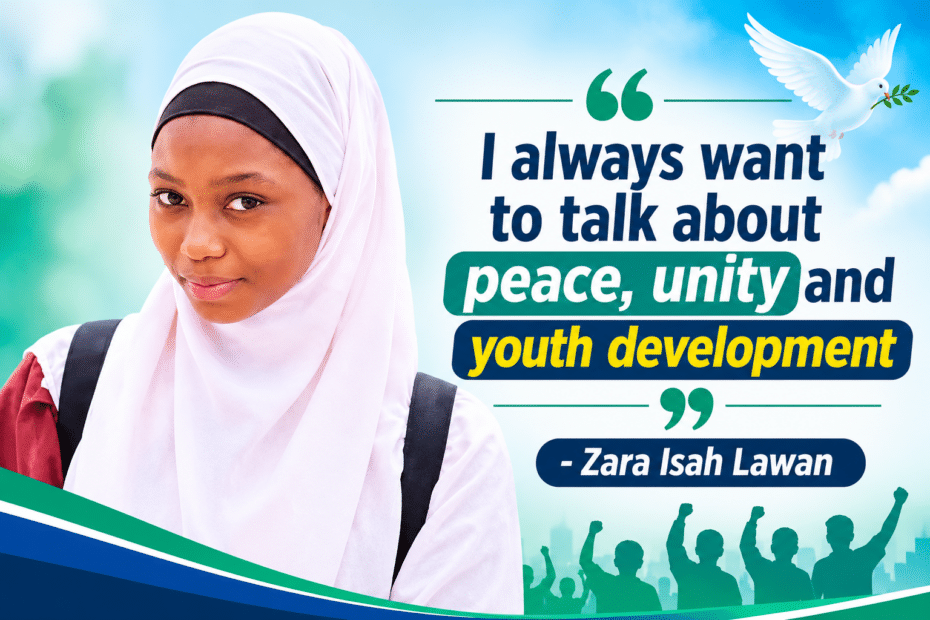
Guest: I always want to talk about peace, unity and youth development.
Presenter: If you were given a stage tomorrow and told that thousands of young Nigerians were listening to you, what issue would you turn into a poem, and why?
Guest: I would turn the issue of youth purpose and potential into a poem. I would speak about young Nigerians who have dreams but lack guidance, opportunities or the support to pursue them. I believe many young people do not lack ability; they lack direction and the right environment to grow. I would want my poem to remind them that their lives have value and that they can become part of the change they want to see.
Presenter: You are passionate about youth development, peace, unity and leadership. Where did these interests come from?
Guest: These interests come from my desire to see young people become more purposeful, responsible and confident in shaping their communities. I have seen how a lack of guidance, opportunities and understanding can affect young people and the society around them. That made me interested in youth development, peace, unity and leadership because I believe meaningful change begins when people are empowered to understand their value and responsibility.
Presenter: We often hear young people described as “the leaders of tomorrow.” Do you think young people should be waiting for tomorrow, or should they already be taking responsibility today? Why?
Guest: I believe young people should not wait for tomorrow; they should start taking responsibility today. Leadership is not only about holding a position or having a title. It begins with the choices we make, the problems we try to solve and how we contribute to our communities. If young people develop themselves and take responsibility today, they will be better prepared to lead tomorrow.
Presenter: You want to use your voice to encourage young people to discover their potential and create positive change in their communities. What is one message you wish more young people would hear?
Guest: I wish more young people would understand that they do not have to wait for someone to give them permission to become who they are capable of becoming. Start with what you have, learn what you can, and take small steps. Your circumstances may not be perfect, but your potential is still worth developing. You can begin creating change where you are, even before you have a title or a platform.
Presenter: What do you think young people are capable of contributing to their communities that they sometimes underestimate?
Guest: I think young people underestimate the value of their ideas, creativity and willingness to act. They may not have much experience or resources, but they can still identify problems, support others, create awareness, volunteer and introduce new solutions. Sometimes, what they see as “just an idea” can become something that genuinely improves their community.
Presenter: You joined BRC because you wanted to read, learn, explore creativity and connect with people who have different ideas and experiences. What were you hoping to find when you joined, and has BRC lived up to that expectation so far?
Guest: When I joined BRC, I was hoping to find a space where I could learn, read more, explore my creativity and interact with people who share different perspectives. So far, BRC has lived up to that expectation by giving me opportunities to engage with literature, discover new ideas and connect with people who inspire me to keep learning and improving.
Presenter: What do you think happens when people from different backgrounds come together around books, ideas and meaningful conversations?
Guest: I think it creates understanding. When people from different backgrounds come together around books and meaningful conversations, they get the opportunity to see the world through perspectives different from their own. It can challenge assumptions, build empathy and remind us that although our experiences may differ, we can still learn from one another and find common ground.
Presenter: You said you enjoy being around people who challenge you to think, learn and grow. What kind of person genuinely challenges you in a positive way?
Guest: A person who genuinely challenges me is someone who is knowledgeable but humble, asks thoughtful questions and is not afraid to respectfully disagree with me. I value people who push me to think deeper, question my assumptions and encourage me to improve without making me feel small. Being around such people reminds me that growth often comes from being willing to learn from others.
Presenter: What is something you are currently learning about life that you wish you had understood earlier?
Guest: I am learning that growth takes time, and I do not have to have everything figured out at once. I wish I had understood earlier that being behind in one area of life does not mean I am failing. What matters is being honest about where I am, learning from my mistakes and continuing to move forward.
Presenter: Zara, you told us that you are still discovering many things about yourself. So let me ask you something you may not have been expecting: if the Zara of five years from now could sit across from you today, what do you think she would thank you for not giving up on?
Guest: I think she would thank me for not giving up on my voice, my education and my desire to make a difference. There will probably be moments when I doubt myself or feel like I am not progressing fast enough, but I hope the Zara of five years from now will look back and be grateful that I kept learning, kept trying and kept believing that my voice could be useful to others.
Audience Questions
Adamu: What call or message would you give to young people who have dreams and ideas but do not understand English, especially in Nigeria where, if you do not speak English, your voice hardly reaches where it needs to go?
Guest: My message to young people is: do not let language become the reason your ideas remain unheard. In Nigeria, English is often the language through which ideas reach wider institutions, organisations and opportunities. But not everyone has the same level of access to it. If you have an idea, learn how to communicate it clearly; and if you cannot express it in English yet, find people who can help you communicate it without changing the meaning of your message.
At the same time, we need to create spaces where young people can express their ideas in the languages they understand best. A brilliant idea does not become less valuable because it was first expressed in Hausa, Kanuri or another local language. We should not only teach young people how to speak English; we should also learn how to listen to their ideas, regardless of the language they speak.
Hawwee: How do you balance everything? How do you manage your time in a way that you can contribute to every one of your responsibilities and interests as they deserve?
Guest: Honestly, I am still learning how to manage my time well. I have different responsibilities and interests, so I try to prioritise rather than give everything equal attention at the same time. I usually focus first on what is most important and urgent, especially my studies and personal responsibilities, then I create time for writing, reading and other interests. I have also learned that I do not have to do everything every day. Sometimes giving something consistent but small is better than trying to do everything and becoming overwhelmed. For me, good time management is not about doing everything perfectly; it is about making sure the things that matter are not neglected.
M. : How do you think platforms like BRC can help young people grow and become better?
Guest: I think platforms like BRC help young people grow by giving them opportunities to learn, express themselves, build confidence and connect with others. It can also help them discover their talents and develop a mindset of continuous learning.
Closing remarks by presenter
Thank you, Zara. Thank you for your honesty, your openness and for allowing us to see beyond the name and the profile. Tonight, we have not simply talked about a student, an aspiring poet or a young person interested in making a difference. We have met a person who is still learning, still questioning, still creating and still discovering who she can become.
And perhaps that is what makes a community like BRC meaningful. We do not come together because we have figured everything out. We come together because we are willing to learn from one another.